Contact details


There seems to be a continuing issue with the 'Comment' feature on the site, so if you do wish to get in touch, you can always make contact via e-mail to greatwarworkshops@gmail.com

Tuesday, 23 May 2017

Thursday 24th May 1917


Trenches in the Hill 60 sub-sector, opposite the Caterpillar


The weather remained very warm and conditions were somewhat quieter. However, Pte. Selwyn Stansfield (see 16th January) was wounded, suffering wounds to his left arm; the details of his treatment are unknown, but he would be evacuated to England five days later.
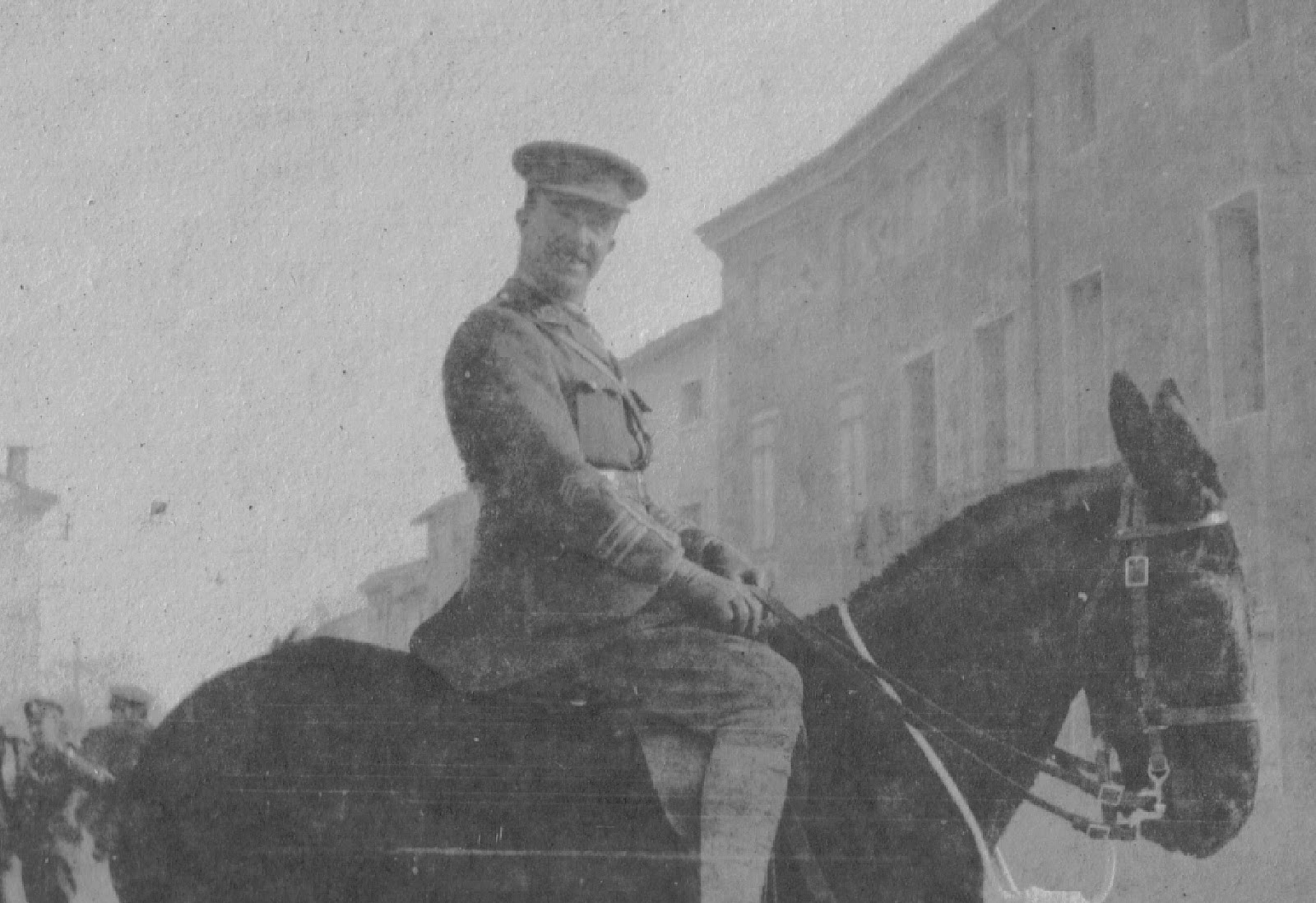
Following the deaths in action of several NCO’s, L.Cpl. Lionel Vickers (see 10th April) and L.Cpl. Dennis Waller (see 5th May) were both promoted Corporal.
 
L.Cpl. Lionel Vickers (standing far left) and other NCOs
Image by kind permission of Henry Bolton
Pte. George Hill (see 11th January) reported sick, suffering from myalgia; he would be admitted via 69th Field Ambulance to 23rd Division Rest Station at Waratah Camp, south-east of Poperinghe.

Pte. Patrick Sweeney (see 19th May), returned to duty from 71st Field Ambulance at Waratah Camp, south-east of Poperinghe, having been spent the previous few days being treated for pyrexia (raised temperature).


2Lt. Thomas Arnold Woodcock (see 7th April), who had served with the Battalion for only three weeks before reporting sick on 7th April, having been treated locally was now sent to no.14 General Hospital at Boulogne for further investigations and treatment.
Pte. William Henry Jordan (see 7th October 1916), who had been serving with 83rd Training Reserve Battalion at Gateshead, was posted back to France and would join 9DWR.

Pte. Thomas Lloyd (see 30th March), who had been wounded twice while serving with 10DWR in 1916, was posted back to France from 3DWR. He was originally due to join 9DWR but would instead to be re-posted to 2/6DWR, joining them on 14th June after spending three weeks at 34th Infantry Base Depot at Etaples.
Pte. Clifford Midwood (see 14th May) who had been in England under treatment for ‘trench foot’ since February was posted back to 3DWR at North Shields. 
Pte. Herbert Greenwood Audsley (see 27th April) serving with the Wireless Depot Company at BEF Headquarters, was admitted to 20th Field Ambulance, suffering from lenticular cataracts.

Trooper Claude Darwin (see 5th March), serving in Egypt with 1st Field Squadron, Engineers, Anzac Mounted Division, was sent to a rest camp near Alexandria for treatment to a minor injury to his right hand. He was the brother of Tunstill recruit, Pte. Tom Darwin (see 20th May), who had recently re-joined the Battalion.
Pte. Frank Hargrave (see 13th October 1916), who had originally served with Tunstill’s Company before being transferred to 9DWR and had been wounded on the Somme in August 1916, was transferred to the Army Reserve, Class P. This classification of the reserve had been introduced in October 1916 and applied to men “whose services were deemed to be temporarily of more value to the country in civil life rather than in the Army”.  Rushworth’s last known occupation prior to enlisting was as a bricklayer, but what work he undertook under his new classification is not known. He was also awarded the Silver War Badge in recognition of his discharge being due to wounds suffered in action.


Pte. George Edward Western (see 24th August), serving with 83rd Training Reserve Battalion at Gateshead, was formally discharged from the Army as no longer physically fit for service on account of wounds; he was awarded an Army pension of 8s. 3d. per week.
A payment of £3 9s 3d was authorised, being an amount found to be still outstanding in pay and allowances to the late Pte. Herbert Bayfield (see 20th February); the payment would go to his widow, Alice.
A further payment of 3s 8d was authorised, being an amount found to be still outstanding in pay and allowances to the late L.Cpl. William Hemp (see 20th March); the payment would go to his mother, Miriam.


Monday, 22 May 2017

Wednesday 23rd May 1917

Trenches in the Hill 60 sub-sector, opposite the Caterpillar

Another very warm day.
At around 5pm seven men from ‘A’ Company were killed when a German shell scored a direct hit on the front line trenches. The Divisional Trench Mortar Battery reported firing 17 rounds, “in retaliation for heavy trench mortars and rifle grenades”. Among those killed was one of the original members of Tunstill’s Company, Sgt. John Thomas Hall MM (see 5th April). 2Lt. Andrew Aaron Jackson (see 14th March) wrote to Sgt. Hall’s mother; “When he, along with six of his comrades were killed, I was in another part of the front, and received quite a shock when I heard of the great misfortune which had overtaken my platoon. By the death of your son I lose one of the smartest and most cheery sergeants in my platoon.” The other men killed were Sgt. John Hudson (see 9th April); Cpl. George Benson Heap (see 28th March); and Ptes. Albert Edward Carter (see 19th December 1916); Harold Illingworth Cawthra (see 9th February); Joe Dyson (see 12th November 1916) and Harold Firth (see 13th May). An unnamed ‘comrade’ would write to the sister Pte. Firth, “I feel it my duty to write you a few lines of sympathy at the loss of your brother Harold. He was killed on Wednesday afternoon at about 5 o’clock. He fell a victim to a German shell, along with six others in the platoon, death being instantaneous. I never met your brother until a few weeks ago at the Base and then we were posted to this Battalion and he shared the same dugout as me and another one or two. I always found him to be very cheery and, like myself, it was his second time in France. The platoon would like you to accept their deepest sympathy in your sad bereavement”.  All seven men were buried the same evening at Railway Dugouts Burial Ground. 


2Lt. Benjamin Owen Hunt (see 22nd May), who had been wounded the previous day, died at no.10 Casualty Clearing Station at Remy Sidings; he would be buried in the adjacent Lijssenthoek Military Cemetery.  
2Lt. Benjamin Owen Hunt
L.Cpl. Fred Atkinson (see 16th May) was admitted via 69th Field Ambulance at Vlamertinghe Mill to 23rd Division Rest Station at Waratah Camp, south-east of Poperinghe, suffering from conjunctivitis; he would be discharged to duty after ten days.

Pte. John Blackburn (see 16th January) was admitted via 69th Field Ambulance at Vlamertinghe Mill to 23rd Division Rest Station at Waratah Camp, south-east of Poperinghe; he was suffering from ‘myalgia’.

Pte. Jacob Carradice Green (see 20th May), who had been wounded three days previously, underwent an operation at 3rd Canadian General Hospital at Boulogne. Shortly afterwards he wrote home to his family, telling them that he was “going on as well as could be expected … I got wounded on Sunday night, with a machine gun bullet and arrived at the hospital on Tuesday morning. I went under X-rays and the operation on Wednesday. They managed to get the bullet, which had entered the left thigh and gone into the hipbone. It seems strange, but I told my mates two months ago that there was a 'Blighty' waiting for me sometime in May".

Pte. Jacob Carradice Green

A review of the pension award which had been made to James Hatton Kershaw (see 22nd December 1916) who had been discharged from the Army in July1916, suffering from tuberculosis, resulted in his pension being increased to £1 16s. 8d. per week.


Sunday, 21 May 2017

Tuesday 22nd May 1917


Trenches in the Hill 60 sub-sector, opposite the Caterpillar


There was much artillery activity, from both sides, again during the day. There was an especially ferocious German bombardment in the early hours during which three men from ‘C’ Company were killed. Ptes. Michael Gallagher (see below), Arthur Gill (14920) (see 5th January) and John Smith (13382) (see 29th July) would all be buried at Railway Dugouts Burial Ground. Pte. Gallagher’s (unnamed) platoon officer would write to his family, “It is my painful duty to inform you that your son was killed by a shell while standing in the trench. As his platoon officer I should like to pay tribute to his unfaling cheerfulness and willingness under all circumstances. He was one of the best lads in my platoon and an example to all and I, as well as his comrades, will miss him sorely. Please accept my deepest sympathy on your bereavement. Your son will be taken back and buried in a quiet little cemetery behind the lines and in due course you will be informed of its locality”. Michael Gallagher had been an original member of the Battalion; he was 23 years old and one of ten children of Anthony and Mary Gallagher. His father was originally from Ireland but the family was settled in Keighley where Michael had worked before the war at a local engineering firm. 
Pte. William Boodle (see 19th December 1916) wrote to Arthur Gill’s family with details of exactly what happened; “about 2.50 am he had just got into a dugout to have a sleep after being on patrol all night, and he had not been in it an hour when the Germans opened a very heavy bombardment upon us. The first shell knocked the dugout in and buried five of us. We got out all right but suddenly found that your boy was still under, being covered with the remains of the dugout. I at once started to dig him out, and after working for an hour succeeded. I then got him onto a stretcher and saw him out of shellfire, as I was for hospital myself.” According to stretcher bearer Pte. John William Atkinson MM (see 4th August 1916), “Arthur was in a dugout which they knocked in with a shell, and he was very badly wounded and died nearly right away”. 

Among those wounded on the same day, though whether in the same incident is uncertain, was 2Lt. Benjamin Owen Hunt (see 25th August 1916). He was evacuated to 10th Casualty Clearing Station at Remy Sidings, Lijssenthoek and a telegram despatched to his parents reporting him to be “dangerously wounded, shell wound, head”. Also wounded was Pte. Fred Addy (see 9th February); he suffered shrapnel wounds to his face and right hand. He was evacuated via 4th London Field Ambulance at Brandhoek and 17th Casualty Clearing Station at Remy Siding, Lijssenthoek to 2nd Canadian Casualty Clearing Station also at Remy Siding. Pte. William Postill Taylor (see 13th May), who had only joined the battalion ten days previously, suffered a wound to his left hand and was treated first at 69th Field Ambulance at Vlamertinghe Mill, before being transferred, next day, to 3rd Canadian Casualty Clearing Station at Remy Siding, Lijssenthoek; from there he would be transferred (24th May), onboard No.2 Ambulance Train, to 32nd Stationary Hospital at Wimereux. Pte. Fred Morrell (see 16th January) suffered shrapnel wounds to his left thigh; he was evacuated via the same route as Pte. Taylor.
2Lt. Benjamin Owen Hunt
Pte. Leonard Briggs (see 16th January) reported sick, suffering from ‘myalgia’ and was admitted via 69th Field Ambulance at Vlamertinghe Mill to 23rd Division Rest Station at Waratah Camp, south-east of Poperinghe. Pte. Thomas Manuell (see 20th February) also left the battalion; he was suffering from ‘trench foot’. He was admitted via 69th Field Ambulance at Vlamertinghe Mill to 23rd Division Rest Station at Waratah Camp, south-east of Poperinghe.
Overnight 22nd-23rd ‘A’ and ‘C’ Companies moved into the front line, relieving ‘B’ and ‘D’ who went into close reserve. In the continuing exchanges of shelling the Divisional Trench Mortar Battery reported firing 71 rounds, “in retaliation for heavy trench mortars and rifle grenades”.

After almost five months away from the Battalion, having been taken sick, Pte. Herbert Kitley (see 30th December 1915) re-joined 8DWR; he had been discharged from hospital on 13th May and then spent two weeks at 34th Infantry Base Depot at Etaples.


Saturday, 20 May 2017

Monday 21st May 1917


Trenches in the Hill 60 sub-sector, opposite the Caterpillar
Another very warm day, with artillery active on both sides throughout the day. Brig. Genl. Lambert (see 12th May) visited the Battalion’s sector, in company with temporary CO Maj. Charles Bathurst (see 18th May). The Divisional Trench Mortar Battery was again in action, firing 78 rounds, “in retaliation heavy trench mortars and rifle grenades”. 
Cpl. Harold Best (see 8th May) suffered minor facial wounds and was treated at 69th Field Ambulance at Vlamertinghe Mill before being transferred, next day, to 23rd Division Rest Station at Waratah Camp, south-east of Poperinghe; he would return to duty five days later.

Pte. Martin Reddington (see 16th January) was admitted to 69th Field Ambulance at Vlamertinghe Mill and from there, on the same day, to 23rd Division Rest Station at Waratah Camp, south-east of Poperinghe; he was suffering from “pyrexia, NYD” (high temperature, not yet diagnosed).
Capt. Dick Bolton (see 14th April), commanding ‘A’ Company, departed for England on ten days’ leave. In his absence, command of ‘A’ Company, in their preparations for the forthcoming Messines attack, would pass to 2Lt. Bob Perks, DSO (see 20th May).
  
Capt. Dick Bolton
Image by kind permission of Henry Bolton
2Lt. Bob Perks DSO
Image by kind permission of Janet Hudson

Pte. Benjamin Fawcett (see 5th August 1915) departed for England on ten days’ leave.
Having spent twelve days being treated for inflammation of the larynx and boils, Pte. Joe Fawcett (see 9th May) was discharged from 23rd Division Rest Station at Waratah Camp, south-east of Poperinghe, and returned to duty.
Pte. Joseph Clough (see 14th May), who had been wounded a week previously, was evacuated from 32nd Stationery Hospital at Wimereux to England for further treatment. Having arrived in England he would be transferred to Edinburgh War Hospital.
Pte. James Pickering (see 4th July), who had been transferred to Army Reserve Class W ten months’ previously and released to resume his former work at Tinsley Park Colliery, Sheffield, appeared before an Army Medical Board assembled at 3rd Northern General Hospital in Sheffield. The findings of the Board are unknown, but there was clearly some doubt as to his fitness for work.
Pte. Herbert Ormanroyd (see 8th October 1916), who had been in England since having been wounded in October 1916, was formally discharged from the Army as no longer physically fit for service on account of wounds; his disability was assessed as being 40% and he was awarded the Silver War Badge and an Army pension.
James Wilkinson, landlord of the Coach and Horses Inn, Bolton-by-Bowland, died; he was the father of James Wilkinson jnr. (see 10th January 1916), who had been one of Tunstill’s original recruits, but had been rejected on medical grounds. James jnr.’s elder brother, Harry, was serving with the ASC.

A payment of £3 10s. 7d. was authorised, being an amount found to be still outstanding in pay and allowances to the late Pte. Arthur Julian (see 29th July 1916), who had been killed in action in July 1916; the payment would go to his father, George.


Pte. Arthur Julian
Image by kind permission of Andy Wade and MenofWorth


Friday, 19 May 2017

Sunday 20th May 1917


The weather continued hot and sunny. Three men from the Battalion were among a draft of 20 from the Brigade who were attached to the Divisional Machine Gun Company. One of those from 10DWR was Pte. Ronald Bray (see 23rd March); the other two have not yet been identified.

Trenches in the Hill 60 sub-sector, opposite the Caterpillar

The weather continued hot and sunny. Three men from the Battalion were among a draft of 20 from the Brigade who were attached to the Divisional Machine Gun Company. One of those from 10DWR was Pte. Harold Bray (see 23rd March); the other two have not yet been identified.


There was further German shelling and the Divisional Trench Mortar Battery reported firing 15 rounds, “in retaliation for a few heavy trench mortars sent over near Grand Fleet Street”. A number of men were wounded; among them was Pte. Jacob Carradice Green (see 7th March) who was struck in the left thigh by a machine gun bullet and evacuated via 4th London Field Ambulance at Brandhoek to 10th Casualty Clearing Station at Remy Sidings, Lijssenthoek; from there he would be evacuated, on 21st, onboard No.5 Ambulance Train to 3rd Canadian General Hospital at Boulogne. Also wounded was Pte. John William Midgley (see 19th December 1916), who suffered wounds to his head and both legs; it is not clear where he was treated, but he would be evacuated to England a week later. On arrival he would be transferred to hospital in Dundee. Cpl. George William Keeling (see 15th May) suffered only a minor wound and remained at duty.
Pte. Jacob Carradice Green

Capt. James Christopher Bull (see 18th May), currently second-in-command of the Battalion, was promoted Temporary Major.
Lt. John Edward Lennard Payne (see 21st March) was promoted Captain and again took command of ‘D’ Company, following the departure of Capt. Edgar Stanton (see 11th May).
Pte. Richard Harrison (see 17th October 1916) was reported by Cpl. George Jellett (see 29th July 1916, it is not known when he had been promoted) for ‘hesitating to obey an order’; on the orders of 2Lt. Bob Perks, DSO (see 11th May) he was to be confined to barracks for six days.

Pte. Thomas Ward (see 28th April) was admitted via 69th Field Ambulance at Vlamertinghe Mill to 23rd Division Rest Station at Waratah Camp, south-east of Poperinghe, suffering from scabies; from there, next day, he would be transferred to 50th Casualty Clearing Station at Hazebrouck.
Pte. Frank Wood joined the Battalion from 34th Infantry Base Depot where he had been since arriving in France on 3rd May. He was a 20 year-old textile worker from Marsden, near Huddersfield.
Pte. Tom Darwin (see 3rd May), who had recently returned to France having being wounded on the Somme in July 1916, now re-joined the Battalion. Pte. Jacob Sweeting (see 6th April) also re-joined; like Darwin he had been wounded in July 1916. Both men had been posted back to France, from 83rd Training Reserve, on 3rd May.
Pte. Richard Palliser (see 17th April), who had been in England for the previous month, was posted to 3DWR at North Shields.


Thursday, 18 May 2017

Saturday 19th May 1917


Trenches in the Hill 60 sub-sector, opposite the Caterpillar

The weather again became very warm. There was heavy shelling throughout the day by both sides. The Battalion War Diary reported simply that, “Much work was done during this tour to improve the trenches and large ammunition, bomb, rations and water stores were formed in view of impending offensive. Owing to enemy retaliation for our heavy bombardments, the Battalion suffered casualties”. 

Although no specific mention is made in the Battalion War Diary, the first of these casualties were incurred on the first day, with two men killed. Pte. Richard Field (see 11th January), who had only been with the Battalion for four months, and Pte. Thomas Kay (see 7th May) were both buried at Railway Dugouts Burial Ground. Among those wounded was Pte. Joseph Barnes (see 7th April); he suffered relatively minor injuries to his eyes and was evacuated via 69th Field Ambulance at Vlamertinghe Mill and 3rd Canadian Casualty Clearing Station at Remy Siding, Lijssenthoek, and from there, on 21st, onboard No.5 Ambulance Train, to 3rd Stationary Hospital at Boulogne. He would stay only a day in hospital before being transferred to 1st Convalescent Depot, also at Boulogne. Pte. Walter Pedley (see 16th January) suffered shrapnel wounds to his head, right arm and left leg and was admitted via 4th London Field Ambulance at Brandhoek and 3rd Canadian Casualty Clearing Station Remy Siding, Lijssenthoek, before being transferred, on 24th, onboard No.2 Ambulance Train, to 13th General Hospital at Boulogne. Pte. Ernest Needham (see 5th February) suffered relatively minor facial wounds; he was treated at 69th Field Ambulance at Vlamertinghe Mill before being transferred, on 20th, to 23rd Division Rest Station at Waratah Camp, south-east of Poperinghe; he would return to light duty with the battalion on 26th. Pte. Henry Marshall (see 8th April) was also wounded by a shell concussion but was treated locally and remained with the battalion. The Divisional Trench Mortar Battery fired 26 rounds in total, “in retaliation for 3 heavy trench mortars and 2 rifle grenades”.

Pte. Patrick Sweeney (see 18th May), who, the previous day, had been awarded 14 days’ Field Punishment no.1, having been absent without leave, was admitted to 71st Field Ambulance at Waratah Camp, south-east of Poperinghe, suffering from pyrexia NYD (raised temperature; not yet diagnosed).
Maj. Robert Harwar Gill (see 19th May) who had been in charge of 69th Brigade School on secondment from 10DWR was transferred to become second-in-command, 11th Battalion Northumberland Fusiliers. 
Maj. Robert Harwar Gill

Pte. John William Dean (see 5th March) who had suffered gas poisoning in August 1916, was discharged from a Convalescent Hospital in Blackpool and given ten days leave before reporting for duty with 3DWR at North Shields on 29th May.
Pte. Thomas Delaney (see 26th February) was discharged from 1st Western General Hospital in Liverpool; he would have ten days’ furlough before reporting for duty, on 29th May, at Northern Command Depot at Ripon.
The weekly edition of the Keighley News reported news of the wounding of Pte. Gilbert Bell (see 24th April) who had originally served with 10DWR but had been posted to 9DWR after suffering shellshock on the Somme in July 1916.

“Mrs. A. Bell, of 76 Chip Hill, Bogthorn, Keighley, has been notified by the Infantry Record Office, that her son, Private Gilbert Bell, of the West Riding Regiment, was wounded on April 25th. He joined the forces at the commencement of hostilities, and had been at the front a considerable period”.


Wednesday, 17 May 2017

Friday 18th May 1917

Scottish Camp, south-west of Brandhoek

There was an improvement in the weather, which again became fine and bright. Lt. Col. Robert Raymer (see 15th May) was taken ill and admitted to hospital. Maj. Charles Bathurst (see 7th April) took temporary command of the Battalion, with Capt. James Christopher Bull (see 4th May) as second-in-command.
Lt. Col. Robert Raymer

Capt. James Christopher Bull
Image by kind permission of the Trustees of the DWR Museum
In the evening the Battalion moved up to the front line, relieving 10th Northumberland Fusiliers in the same positions that they had held a month earlier (see 14th April) in the front line trenches in the Hill 60 sub-sector, opposite the Caterpillar, south of the railway cutting.  The relief was a difficult one as, from 6.15pm the Germans bombarded the sector, and especially the point known as SP9  (I.28.a.6.4) with guns of calibres up to and including 21cw. Several dugouts were blown in. The relief finally began but was delayed owing to the late arrival of the Lewis gun sections and was not finally completed until 2.30am (19th May). On arrival, two Companies, ‘B’ and ‘D’ went into the front line from the railway cutting south west to I.34.b.7.8. ‘C’ Company was in close support in the sunken road at I.28.d.3.3 and ‘A’ Company was held in reserve at SP9 (I.28.a.6.4).

Pte. Patrick Sweeney (see 17th May), who had been absent without leave for more than 40 hours before returning to duty the previous day, was awarded 14 days’ Field Punishment no.1.


L.Cpl. James Arthur Heap (25th February) was reported by Sgt. Joseph Bona (see 14th May) and Cpl. William Hutchinson (see 26th January) as having been “drunk whilst proceeding to the trenches on the night of 18th/19th”; on the orders of Maj. Bathurst (see above) he was to be reduced to the ranks and to undergo 21 days Field Punishment no.1.


Lt. Paul James Sainsbury (see 28th April) who had been in an officer’s convalescent hospital following an operation to remove his appendix, resumed light duties with 3DWR at North Shields.

Lt. Paul James Sainsbury


The weekly edition of the Craven Herald carried news of Cpl. Fred Swale (see 2nd May), who had returned to England to begin his officer training.

AUSTWICK

COMMISSION FOR LOCAL SOLDIER

Corporal Fred Swale, younger son of the late Mr. N.S. Swale, Main Street, has been offered and accepted a commission. He is at present at home on a month’s leave prior to entering into training. He joined the Duke of Wellington’s Regiment at Settle in September 1914, and went to France the following year, where he has been up to the present time. Corporal Swale is one of few left of Captain Tunstill’s hundred.

Cpl. Fred Swale

There was also news in the West Yorkshire Pioneer of Johnny Bradley (see 7th June 1915), younger brother of Pte. Willie Bradley (see 22nd October 1916).

COWLING

WOUNDED SOLDIERS

Pte. Johnny Bradley of the West Riding Regiment has been wounded whilst fighting with the Army in France. He is at present in the Leeds General Infirmary, and is suffering from a shrapnel bullet wound in the left arm. Pte. Bradley, who has two brothers serving in France, enlisted in June 1915 and has visited France on two occasions, in addition to a short spell of service with the forces in Ireland.

Pte. Willie Bradley