Contact details


There seems to be a continuing issue with the 'Comment' feature on the site, so if you do wish to get in touch, you can always make contact via e-mail to greatwarworkshops@gmail.com

Tuesday, 12 January 2016

Thursday 13th January 1916

Front line trenches north of Rue du Bois.


At 12.30 am a patrol from ‘B’ Company went out into No Man’s Land, comprising of 2Lt. Samuel Lawrence Glover (see 27th August 1915), along with Cpl. Herbert Waddington (see 7th April 1915) and Ptes. Albert Edward Lawton (see below) and Frank Peel (see 11th September 1915). The patrol got over to the German barbed wire without seeing anything. Once arrived there 2Lt. Glover and Cpl. Waddington, leaving Ptes. Lawton and Peel behind, had started to crawl under the German wire to see how strongly their trenches were held. Half way through, however, the Germans had sent up a flare, and had fired heavily on the two who were fully visible. Cpl. Waddington had been heard to call out, "I am done for," but 2Lt. Glover had never moved, having apparently been killed at once. Of the other two members of the patrol, Pte. Lawton was hit, and sent Pte. Peel back for help; he, however, had lost his way and wandered all night before returning to the British lines at 9 a.m. Despite being referred to as having returned “in a very exhausted state” and being “off his head for two days” Peel was able to confirm that both Glover and Waddington had been killed and that Lawton had been close by at the time but he could not be sure what had happened to him. 
Concern about the patrol had been raised when they had not returned, and at 3 a.m. Capt. Herbert  Montagu Soames Carpenter (see 5th September 1915), commanding ‘B’ Company, had sent out a party to search for the missing men, but they had found no sign of them. However, later in the day another patrol, led by Lt. Harold Lockhart Waite (see 27th August 1915), was sent out to look for Glover and the others. They reported that they had seen Glover’s body on the German wire but had been unable to recover it.
Samuel Lawrence Glover was born in St Helens on 1st June 1895, the first child of Thomas and Ada Glover; Thomas worked as a gasworks manager. The family subsequently moved, first to West Bromwich and then to Norwich, where they were living, at Cliff House, St Leonard’s Road, on the outbreak of war. By then there were two younger children, Christine and Thomas Bernard. Samuel Glover had been educated at Mill Hill School, London between 1910 and 1913 and had then worked as a ‘pupil’ at the gasworks managed by his father. On 7th September 1914 Samuel had enlisted in London with the Public Schools Battalion, Middlesex Regiment, with whom he remained until being commissioned on 3rd January 1915. He had then been posted to 10DWR and arrived with the Battalion in France in August 1915.
Albert Edward Lawton was a 21 year-old dyers’ labourer (working for Messrs. Holden and Burnley) from Girlington, Bradford; he was married with one daughter. 

Lt. Samuel Lawrence Glover
The remainder of the day, with some light rain falling, passed off fairly quietly.


The fate of Lt. Glover’s patrol was referred to by Pte. William Knox (see 8th January), as he once again wrote to his wife, Ethel (I am most grateful to Rachael Broadhead and family for allowing me access to William’s letters).

“I now sit down and write you a few lines hoping they will find you quite well as I am very pleased to say that it leaves me very well just at present. We are in a very dangerous place just at present. It is an old farm building where we are billeted just behind the firing line and I can tell you we have to be very careful how we go about as bullets are flying all about us. You ought to see the old ruins. It is heart-rending to see it.

I received a parcel from home for my birthday. It contained a plum pudding, a cake, mince pies and about a dozen apples. It came in very handy. I boiled my pudding in my canteen and it was extra but I was not able to make any sauce as we were in the trenches.

The first from Lord Derby’s Scheme will soon be in training now and I’ll bet they have a hard time of it too. The Boshes have just started sending a few shells again. It was a grand sight to see our guns letting go on Tuesday night about twelve o’clock. It was pitch dark but when they started it was lit up all over for miles about us and the Boshes sending us some over as well and sending red flares up. It was a real fifth of November do but it was on a different mission. I have just received a parcel from Dolly. It is an iced cake for my birthday. It is rather late, but better late than never.

Our Battalion had a bit of bad luck last night. We sent a patrol of men out and by all accounts they must have come across a German patrol larger than themselves as only two of them has returned up to eleven o’clock this morning so the other four will be either killed or taken prisoners.

The Boshes would not half have a tale to tell in Berlin as they brought one of our aeroplanes down yesterday but we got one of theirs down on Sunday afternoon so it was only tit for tat as they say. When you send another parcel will you send me a lead pencil as it is a job to get one here. I think we go back for our Divisional rest on Saturday but will let you know next time I write”.


Pte. George Wallace Fricker (see 12th October 1915) was posted back to England; the reason for his departure is unclear and it has not been established whether he was wounded, ill or simply posted back for alternative duties.
Ptes. Fred Angus (see 15th August 1915) and Thomas Riding (see 21st October 1915) went home to England on one weeks’ leave; for Thomas Riding this would allow him to see his first child, Thomas, who had been born in October.


Monday, 11 January 2016

Wednesday 12th January 1916

Front line trenches north of Rue du Bois.

With the weather again good, there was a continuation of the artillery duels of the previous day and the men of the Battalion also witnessed a British aircraft shot down over the German lines. The incident was recorded at some length in the Battalion War Diary, “He passed over our lines on the right and had traversed about 2 miles beyond the enemy lines when a shot from one of their anti-aircraft guns hit his machine. He fell quickly for about 100 feet then his machine caught fire. According to further reports both pilot and observer were seen to jump from the machine, the fate of them is not known”.
In the early evening there were considerable activity further south, with exchanges of rifle, machine gun and artillery fire.


Pte. John Etchells (see 28th September 1915) was evacuated to England, suffering from TB; on arrival he would be transferred to Dalmeny House Hospital, Edinburgh.


Sunday, 10 January 2016

Tuesday 11th January 1916

Front line trenches north of Rue du Bois.

The weather remained good. In the morning the Germans began a considerable bombardment of Rue Marle, Chapelle d’Armentieres and Armentieres itself, in the course of which a number of civilians were killed and wounded. From 11.30pm there was an exchange of artillery further north where men from 21st Division had been raiding the German lines. In the Battalion sector conditions overnight remained quiet.

CQMS Donald Roy Auty (see 9th July 1915) was admitted to 70th Field Ambulance, suffering from diarrhoea; he would be discharged to duty three days later.

L.Sgt. Richard Farrar (see 7th December 1915) was reported for ‘neglect of duty’ (details not specified) by Lt. Harold Lockhart Waite (see 27th August 1915), CSM Alfred Swan (see below), Sgt. David Frederick McKrill (see below) and Pte. Dick Hinchliffe (see below); he would be reprimanded by Lt. Col. Hugh John Bartholomew (see 21st November 1915), but would suffer no further sanction.

Alfred Swan had been an original member of the Battalion. He was a 31 year-old boilermaker from Halifax and was well-known rugby player; he was married, with two children. David Frederick McKrill had been an original member of the Battalion; he had been promoted Lance Corporal while the Battalion was still in England and further promoted to Sergeant whilst in France. He was 27 years old and from Middlesbrough, where he had worked as a clerk before enlisting. Dick Hinchliffe had also been an original member of the Battalion; he was a 19 year-old twister from Huddersfield.

It may have been during this period in the trenches that the photograph below was taken. The image comes from an album assembled by Lt. Dick Bolton (see 2nd January) and he captioned it as featuring, “Ptes. Jowett (William Henry Jowett, see below), Wilkinson and self, Jan. 1916, in trenches at Armentieres”.
I am indebted to Henry Bolton for his permission to use this and many other photographs, and for his invaluable support.
William Henry Jowett had volunteered in September 1914 at the age of 24. He was the third of four sons of Henry and Nancy Jowett of Keighley; he had been working as a mill mechanic before the war. He had not been one of the original Keighley contingent attached to Tunstill’s Company. It has not been possible to make a positive identification of Pte. Wilkinson due to the frequency of this surname in the Battalion.
CSM Harry Dewhirst (see 8th January) reported for duty at the Regimental Depot in Halifax, having been sent home as unfit for active service.

Monday 10th January 1916

Billeted in huts near Rue Marle.

There was some ‘excitement’ in the morning when three officer’s servants from ‘B’ Company apprehended a suspected enemy spy, who had been “asking for information regarding the residence of the General and Commanding Officers billeted where we are”. 
The Battalion moved off from billets from 4.30pm (although representatives from each platoon had moved two hours earlier in order to take over trench stores) to move to the same sector of the front line which they had occupied on the previous tour. By now conditions had somewhat improved; “the water has to a great extent been got rid of”. On this tour, most of Tunstill’s Men were not deployed in the front line but instead remained in close support in the Bois Grenier Line, although one platoon was stationed further forward at Battalion HQ at Farm du Biez, along with “12 first class bombers” from the Company who were to be placed under the command of Lt. Laverack, Battalion Bombing Officer. The relief was duly completed without incident.


Sgt. Arthur Walton (see 2nd January) was reported ‘absent without leave’, having failed to return on time from his leave to England.

Pte. Richard Swallow (see 17th November), serving with 11DWR at Brocton Camp, Staffs., having been evacuated to England after suffering an accidental wound to his foot in November 1915, was reported absent without leave. The military authorities would request assistance from the local police and Pte. Swallow would be detained at his home on Saturday 15th January; he would appear in court in Halifax and would be remanded to await a military escort before being returned to Brocton. The nature of his military punishment is unknown.

A Medical Board convened at Shorncliffe Military Hospital to consider the case of Maj. Harry Hildyard (see 7th January) found that he was suffering from “nervous exhaustion … this officer who is now on leave from France complains of loss of memory, sleeplessness and general inability to properly perform his duties. There is slight muscular tremor.’ Hildyard was declared unfit for general service and a further examination was set for one month’s time. At the age of 43 the rigours of trench life, in the appalling conditions with which the Battalion had been faced, had clearly taken their toll on Hildyard.

With Hildyard’s absence confirmed, Capt. Gilbert Tunstill’s command of ‘A’ Company was now to become permanent.
Cpl. Harry Wilkinson, serving with the ASC in Egypt wrote home with thanks for a parcel he had recently received; his letter was subsequently published in the Craven Herald (11th February). Harry was the elder brother of James Wilkinson who was one of the men from Bolton-by-Bowland who had originally volunteered for Tunstill’s Company but had been rejected on medical grounds (see 14th September 1914).
"Just a few lines thanking you and the Bolton War Committee for remembering me with another of their many kindnesses. I received your parcel yesterday, and I notice it has escaped going down with the mail steamer Persia. I am very sorry to say that thousands of parcels and letters for the troops went down with her. By the time you receive this, you will all know that the Gallipoli Expedition has been given up entirely, and to tell you the truth it does not go down very well with the troops; all the same, everybody seems glad to get off. Things are not working very smoothly in Egypt by any means. We hear that we are having relief in March, but we are not too hopeful of getting it, though we ought to stand a good chance, for we were in the first ship out from England on the Mediterranean Expeditionary Force. I have still to meet the person out here that I know, and I have seen most of the Lancashire Regiments, and met some of the West Ridings, who belonged to the same battalion as the Bleazards, but they did not know them. I hope the Bolton lads are doing well and keeping safe in France. Taking things as a whole we had a decent time at Christmas and New Year, and had turkey, ham and beer for our Christmas dinner. It needs all our resources to beat this formidable enemy, for we are up against a stiff obstacle. Everybody who has met the Turks gives them credit for being splendid fighters and clean with it."


A payment of £5 7s. 1d. was authorised, being the amount due in pay and allowances to the late Pte. Fred Job (see 18th October 1915) who had died of wounds in October 1915; the payment would go to his father, Francis.


A payment of £2 13s. 11d. was authorised, being the amount due in pay and allowances to the late Pte. Allan Hiley (see 1st October), who had been killed in action in October 1915; the payment would go to his father, Charles.

Friday, 8 January 2016

Sunday 9th January 1916

Billeted in huts near Rue Marle.

Another quiet day, with the weather remaining good and the Battalion again providing working parties. Orders were issued for the Battalion to return, next day, to their former front line positions, relieving 9th Yorkshires. 

Pte. Jacob Sweeting (see 29th August 1915) was admitted to 70th Field Ambulance, suffering from scabies; he would be discharged after ten days treatment.

At some point in January (the exact date has not been established) Pte. Willie Waggitt (see 19th November 1915) joined Tunstill’s Company; he had originally served with 9DWR but had been wounded in August 1915 and had spent several months in England recovering from his injuries.

Pte. Willie Waggitt

A memorial service was held at the Parish Church in Bolton-by-Bowland in remembrance of Pte. Harold Carey, who had been killed two weeks earlier; he was the older brother of Norman Carey who had been one of Tunstill’s original volunteers (see 27th December 1915). The service was subsequently reported (14th January) in the Craven Herald, which also carried extracts from letters from Harold Carey’s fellow soldiers.
BOLTON-BY-BOWLAND - PRIVATE HAROLD CAREY KILLED
Quite a gloom was cast over the village of Bolton by Bowland when the sad news was received from the War Office by Mr. Alfred Carey, of the Copy Nook Hotel, that his son, Harold, was killed instantaneously on December 27th whilst in the trenches in France. Deceased joined the 'A' Company, 6th Duke of Wellington's, twelve months ago, and has been at the Front since the middle of June. Private Carey is, as far as known at present, the first in this parish whose life has been sacrificed for his King and Country, and his father and mother have the sympathy of all who know them.
They have received several letters from the Front, one from Lieutenant Stocks, who says:- "On behalf of the Officers, N.C.O.'s and men I wish to express to you our deepest sympathy in your great loss. Since your son joined us out here he has always shown plenty of pluck and fearlessness, and we are all sorry to lose him."
Pte. F. Clarke writes:- "Just a few lines to tell you of the death of your son Harold. He was my best friend out here. I was with him in the dug-out at the time of his death. We were having a sleep when the dug-out was hit by a German shell, a piece of which hit Harold and he drifted right away. All the boys feel it as if he was our own brother. He was a good soldier, and was liked by all his mates. We had our Christmas dinner together, and he was talking about bringing me to dinner after the war."
Pte. J. F. Core also writes:- "Just a line to let you know how deeply I sympathise with you in the death of your son Harold. Being a mate of mine all the time he was in training and in active service, I thought it was as little as I could to write a few lines to you. He was killed by a shell which came through the dug-out when he was in it. He was killed instantly and was a good soldier, always doing his duty, and was always ready to do a good turn for anybody and I can only say how deeply we all regret to lose such a good pal."
At the Parish Church on Sunday morning hymns which had been special favourites of the dead soldier were sung, and the Rector (the Rev. C. C. Broadhurst) in preaching on the subject of Christ's miracle of changing water into wine continued:- "And then there is the change from life unto death. To some, that change comes gradually but to some it comes suddenly as to Harold Carey, who died on the 27th in his country's service. His passing has brought, or ought to have brought, the war very near to every inhabitant of Bolton; for though some months ago Arthur Bleazard* was reported missing, yet we hope, may we not hope in vain, that he may still be alive, though a prisoner; but Harold Carey is the first on our Bolton list to have given his life in fighting for his country, but in this we feel that he died without pain. We must be more determined than ever to do all that is in our power to carry this war to a righteous conclusion."
After the services, the Prayer of Commendation in the Burial Service was read, and afterwards Mr. Lambert played the Dead March in 'Saul.'

*Arthur Bleazard had been reported missing on 12th August 1915, while serving with 8DWR in the Dardanelles; he was later posted as having been killed on or about that date. He is commemorated on the Helles Memorial.

Thursday, 7 January 2016

Saturday 8th January 1916

Billeted in huts near Rue Marle.

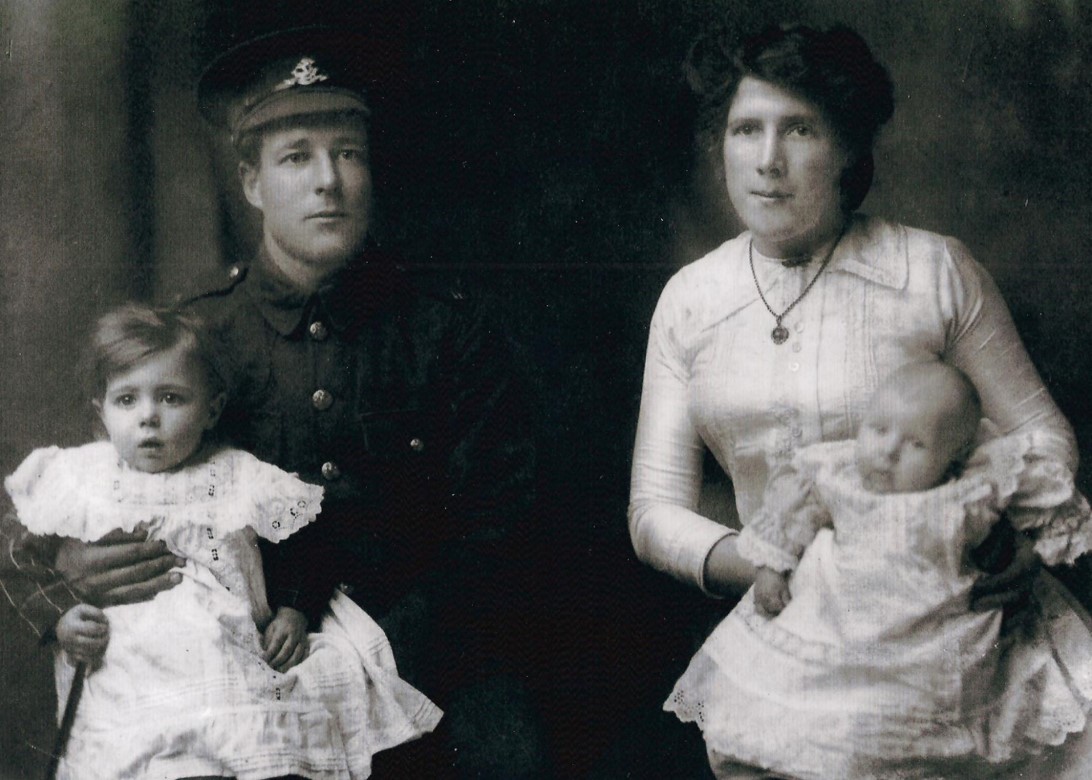
The weather remained good and conditions quiet, with the Battalion again providing working parties. As one group of men returned from leave (see 2nd January), so another departed to England for one week; among them was Pte. Tom Darwin (see 3rd December 1915). It may have been at this time that another of Tunstill’s original recruits, Pte. Solomon (Sammy) Webb was home on leave; his second child had been born in October 1915 (see 4th October 1915) and at some point Sammy was at home and had a studio portrait photograph taken of the whole family.


My thanks to Judith Webb and Eileen Bamford for the information on Sammy Webb and for their kind permission to use the photograph.

The issue of leave was also prominent in the thoughts of Pte. William Knox (see 4th January), amongst other issues, including German atrocities, as he once again wrote to his wife, Ethel (I am most grateful to Rachael Broadhead and family for allowing me access to William’s letters).

“Just a few lines to let you know that I am keeping quite well. Hope you are the same. I have just received your letter dated 3.1.1916. We are out of the trenches again just now. Came out on Thursday night after four days in the firing line. It has been very quiet this time and the weather has been quite alright. About the best we have had since I came out here. It only rained about four hours all the time. We go in again for another four days Monday night and then it is rumoured we go right back for a rest but I don’t know if it is correct or not as we hear so many different tales you don’t know which to believe.

I am pleased to hear that you are enjoying yourself so well. I hope you will have as good a time as you can and it will not make it any better if you worry about me being out here. I have wrote to Lizzie today to let her know that I received the parcel quite safe. We have got a very nice billet this time. We are in a front room; ten of us altogether so we have a bit of fun of a night. The people are very nice and also very good. They make us coffee every morning and bring it to us while we are in bed as we do not get up before eight o’clock now. And they have an organ that turns with a wheel so you may guess what a time we have of it. The woman is a refugee and by what she tells us she has gone through something. When the Germans occupied this place where we are now they came into the house and killed four of her brothers at once and bayonetted three of her children. The oldest was only seven years old and she has got one with her now that they cut both his hands off. It is an awful sight to see him and he is such a bonny little lad. He is about four years old. But on top of that she has got a little girl that a German left her with. So you know what the poor woman has had to go through here. And then they say if you ever happen to come across a German have mercy on him. But it is impossible for us out here to do so after we have seen with our own eyes what they have done. If some of the young men who are still slacking at home could only see instances like that they would soon make up their minds whether it was their duty to enlist or not. I hope to God that my Precious Wife or anybody belonging to me will have to go through anything like they have to go through. I know now, if I never did before, that I was only doing my duty when I enlisted and if I live to come through this awful ordeal I shall always be able to say I did my little bit.

I have just heard that we go into the reserve trenches for eight days. So we shall have a good time of it if it is correct as we shall be over a mile from the firing line. It will be the first time our Company have been in the second line of reserves. We shall be able to sleep all day and night unless I am on guard. Well Dear you say if you was me you would not take a stripe but I think I shall do. I am Acting Lance Corporal this time in the firing line and I had an easy time of it but I shall not take it unless they pay me for it as there are so many Lance Corporals out here who are not getting any extra money. But when the Sergeant asked me about it I told him straight I should want paying for it.

Well Dearest Love I am not quite sure how long it will be before I get my pass but the Sergeant that came out with us is coming home on the 17th of this month and he says that he thinks that the married men of our draft will be coming next. There are only three more of the original Battalion and I shall come third in our draft so it may be about six weeks time but will be able to let you know more definite in a week or two’s time. And we will not half have a good time of it then. I won’t half make a fuss of you. I bet I shall hug and kiss you all away. I am longing to see you Lovey as it seems ages since I saw you last. But I would rather the war finish before my leave is due so as I should not have to leave you at all again as long as ever we live. It will take something to make me leave you again. Remember me to Thomas and Jenny and Kiddies. Hope they are all quite well. Well I am afraid I shall not be able to come and see them when I come home as I shall want as much rest as ever I can get. You know I am having forty-eight hours in bed the first go off, so it will only leave me four days”.

Prior to returning to the Front from leave at home Pte. Harold Charnock (see 2nd January) wrote a letter of thanks which would subsequently (15th January) be published in The Halifax Courier; “Sir – I beg a short space in your paper to tender my deepest gratitude to my neighbours of Mary Street for the hearty welcome and present of an illuminated watch which I received while on my short leave from the front, also for the good wishes I take back with me”.

Pte. Harold Charnock

It seems to have been around this time, although the precise date has not been established, that Pte. Johnny Smith (see 8th October 1915) wrote home to Mr. Flint, who was one of the organisers of the continuing effort to provide ‘comforts’ to the recruits from the village of Addingham: “Thanks for parcel received all right; everything in it was very good. We are kept busy; when not in the trenches we are always going out on working parties, and as it is soon dark we don’t seem to have much time to ourselves. I liked the photo of the old church immensely and would not mind if I was looking at it just now. I sent it back home and shall keep it to look back at, though it won’t need that to remind me of this war, as things we have seen up to now we shall never forget. The weather is not bad and will soon be better. There is not much doing just now. Wishing you all a prosperous New Year”.


Pte. Johnny Smith

Pte. Harold Brooksbank (see 7th December 1914) relinquished his appointment as cold shoeing smith and returned to regular regimental duties. 
Almost two months after first being reported unfit for duty CSM Harry Dewhirst (see 5th January) was finally sent back to England.

Wednesday, 6 January 2016

Friday 7th January 1916

Billeted in huts near Rue Marle

By 7am ‘A’ and ‘B’ Companies were settled in their new billets near the Erquinghem-Armentieres road west of Rue Marle, with the rest of the Battalion in the village itself. In the event of any alarm all companies were ordered to assemble by the shortest route in the fields west of Rue Marle.
Pte. George Henry Hansford (see 11th September 1915), who had arrived in France with a draft in September 1915, but had been posted to ‘a course of transport’, finally joined the Battalion.
Maj. Harry Hildyard (see 21st August), commanding ‘A’ Company, departed for a one week leave to England. He travelled first to Boulogne and from there to Folkestone, before travelling on to his home in Hythe. On arrival in England Maj. Hildyard requested that he be examined by an Army Medical Board which was duly convened to meet at Shorncliffe Military Hospital on 10th January.
With the departure of Maj. Hildyard, Capt. Gilbert Tunstill (see passim) took temporary command of ‘A’ Company, which had always been known locally and colloquially as ‘Tunstill’s Compnay’. His introduction was to be a relatively quiet one as the next three days in billets passed off largely without incident in mild and fine weather, although working parties were found each day for the front line.

Sgt. Edward Hunter (see 4th November 1915) departed for England on one week leave.

L.Cpl. Thomas Angus McAndrew (see 29th August 1915) reverted to the rank of Private.
The weekly edition of the Craven Herald published letters from two members of Tunstill’s Company, Ptes. Tom Swales and John Dinsdale (see 15th December 1915).

The Brighouse Echo, in an article about the receipt of parcels from the Brighouse Christmas Parcels Fund, noted that, “Pte. Charles Holgate (see below), 10th West Riding Regiment, who received his parcel on December 28th, returns thanks and says he has had a real good time in the circumstances”. Charles Holgate was 19 years old and from Brighouse, where he had worked as an apprentice at the Brighouse Corporation gas works. He had first gone to France with 9DWR in July 1915 and had been wounded and posted back to England in November 1915; the exact date and circumstances of his joining 10DWR are unknown.