Contact details


There seems to be a continuing issue with the 'Comment' feature on the site, so if you do wish to get in touch, you can always make contact via e-mail to greatwarworkshops@gmail.com

Sunday, 21 August 2016

Tuesday 22nd August 1916

Reserve trenches south-west of Ploegsteert Wood

Having completed the digging of the new trench, the Battalion was relieved by 11th West Yorks; the relief began at 4 pm and was completed, without casualties, by 5.30. Lt. Dick Bolton (see 11th August), with an advance party, had left at 1.30 pm and had secured billets for the Battalion four miles to the south-east in huts along the Rue du Sac near Pont d’Achelles. On arrival a congratulatory message was received from 69th Brigade HQ; “The Brigadier is much pleased to learn of the excellent work done by the Battalion last night in digging the new trench in front of the line”. There was a message also from 23rd Division HQ; “Please convey my congratulations to all those who under your orders carried out the good work digging and wiring the new trench in front of trenches 127 and 126”.
Lt. Dick Bolton
Image by kind permission of Henry Bolton

Capt Tunstill wrote to the family of Acting Sgt. Albert Herd (see 21st August) with news of their son’s death,
“I am distressed to have to tell you that your son, Sergeant A. Herd, of my Company was killed last night by a bullet. You have my deepest and heartfelt sympathy in your loss of such a brave son and may God comfort you in this loss. It may be some little consolation to you to know that he gained his promotion through conspicuous gallantry on the field during our recent attacks and his name has been sent by me twice for great bravery and good work. We of the Company, Officers, N.C.O.’s and men all regret his death as he was a great favourite with us and had gained the confidence and respect of all. One thing, he did not suffer pain; he was unconscious from the time he was hit until he died ten minutes later. We buried him today in a little cemetery and a cross will mark his grave. I have asked the Chaplain to write to you. Our own Chaplain, who was very fond of your son, is unfortunately away, but the Chaplain who buried him will write you”.
Herd, was buried, along with other two men killed, Ptes. Horner and Preston, at Berks Cemetery Extension, west of Ploegsteert Wood.

Sgt. Albert Herd

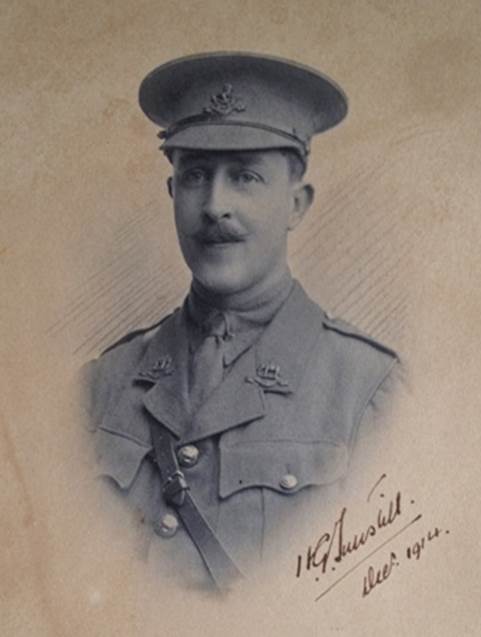
Capt. Harry Gilbert Tunstill


Lt. Robert Stewart Skinner Ingram (see 30th May), who had left the Battalion three months earlier to join the Royal Flying Corps completed his period of training and was “accepted for permanent employment with the RFC”.

(Temporary) Major Christopher Galbraith Buckle (see13th July) who had spent two months with the Battalion in the Summer was appointed (Acting) Lieutenant Colonel whilst commanding 2nd Northants.


A ceremony was conducted at East Dereham (Norfolk) Red Cross Hospital for the presentation of the ribbon of the Military Medal to L.Cpl. Christopher Leigh, who had been awarded the medal for his conduct in the actions around Horseshoe Trench (see 5th July). Leigh was being treated for gunshot wounds in the back and leg, and was said to be, “well on the way to recovery”. The report concerning the award from Brig. Genl. T.S. Lambert, 69th Infantry Brigade, was read: “During operations east of La Boiselle on July 5th, this NCO took part in the first bombing attack down Horseshoe Trench and after Lt. Lavarack had been killed took charge of the bombing party. He led with the greatest gallantry the second and third attacks when under heavy bombing, rifle and grenade fire. He continued to lead the bombing attacks until wounded, and the gallantry of this NCO may be gauged by the fact that out of one officer and twelve other ranks all but three men were killed or wounded.”
The Vicar, as Commandant of the Hospital, congratulated L.Cpl. Leigh and said that so many brave deeds had been performed during the war that it was all the greater honour that one of their soldiers should have gained it. Dr. J.K. Howlett, one of the honorary medical officers, in making the presentation, said, “Many men desired to distinguish themselves, and it was not all who had the opportunity of doing so. Many of them equally deserved an award of that sort but could not get it; nevertheless they had the satisfaction of feeling that they had all done their bit”. Three cheers for L.Cpl. Leigh followed.

Once recovered from his injuries, Leigh did not re-join 10DWR but was instead transferred to the Military Foot Police, with whom he served until he was discharged from the Army on 25th June 1919.


Monday 21st August 1916

Reserve trenches south-west of Ploegsteert Wood

The main purpose of their stay in the reserve lines was revealed to the men. Secret orders had been received before the Battalion had moved forward which had provided for a large working party to dig a new section of trench on the front line north-east of Ploegsteert Wood. There was currently a weakness in the British positions because a slight rise in the ground in No Man’s Land south of Prowse Point meant that a section of the German front line could not be seen from the British trenches. The Battalion was to dig 400 yards of new trench south east from Prowse Point which would straighten and advance the British line and bring it within 120 yards of the Germans.

The working party was assembled for inspection at 11am under the command of Major Robert Harwar Gill (see 13th August), with Capt. Tunstill as the ‘supervising officer’ and comprised of 12 officers and 350 men and 35 NCO’s assembled from all four Companies. Along with Tunstill himself, ‘A’ Company provided 100 men and 10 NCO’s led by 2Lts. Harry Harris (see 10th April) and Frank Redington (see 29th July). Capts. John Atkinson (see 29th July), James Christopher Bull (see 18th August) and Adrian O’Donnell Pereira (see 5th May) were in charge of the other Companies’ contingents. The other officers engaged were 2Lts. Ernest George Costello (see 19th August), David Lewis Evans (see 30th July), Howard Thurston Hodgkinson (see 30th July), Henry Kelly (see 17th August) and Henry Herbert Owen Stafford (see 2nd August).


The working party commenced its task after dark on 21st and by 3.30 am on 22nd the digging of the new trench had been “successfully accomplished … without alarming the enemy”. The new trench was duly named ‘The West Riding Trench’. However, the party had suffered two men killed, one died of wounds and five others wounded as a result of “stray bullets”. One of the men killed was ‘Tunstill’s Man’, Acting Sgt. Albert Herd (see 3rd August), who had only recently written home with positive news of his progress. The other two man killed was Pte. Edgar Preston; he was a 20 year-old warehouseman from Bradford and had been posted to 10DWR at some point in 1916 (date and details unknown). The man who died from wounds was Pte. Frank Horner (see 6th June). All three men would be buried at Berks Cemetery Extension, west of Ploegsteert Wood.

Sgt. Albert Herd
Four of the wounded men have been identified. Pte. Albert Ellis (see 22nd June) suffered wounds to his left arm; he would be evacuated to England on 24th August and admitted to Redburn Auxiliary Hospital in Eastbourne. Pte. Joseph Leonard Holmes (see 6th June) suffered a relatively minor wound to his left forearm and appears to have been treated locally. At least one man was wounded. Pte. Thomas Robinson (16490) (see 19th November 1915) suffered facial wounds; he would be evacuated to England on 24th August and admitted to Lord Derby’s War Hospital in Warrington. Pte. Albert John Start (see 4th May) suffered wounds to his left arm; he would be admitted to 8th Stationary Hospital at Wimereux.

Ptes. Daniel Brennan (see 29th July) and Isaac Robinson (see 17th July) had been reported by Sgt. Edgar Shuttleworth (see 6th August) as “unshaven on am parade”; on the orders of Capt. James Christopher Bull (see above) both were to be confined to barracks for three days.
Former member of Tunstill’s Company, Acting Sgt. George Clark (see 12th August), now serving with ASC, Motor Transport Section, based at Bulford Camp, Wiltshire embarked with his unit for France.


Saturday, 20 August 2016

Sunday 20th August 1916

Reserve trenches south-west of Ploegsteert Wood

Conditions remained as for the previous day.


Capt. George Reginald Charles Heale MC (see 18th August) was evacuated to England from Boulogne admitted to the Kitchener Hospital in Brighton for treatment to the boils to his neck which had been troubling him for the previous few weeks.


Lt. George Reginald Charles Heale


Ptes. Patrick Conley (see 14th August) and John Onion (see 31st July) were posted from the Regimental Depot at Halifax to 11DWR at Brocton Camp, Cannock Chase.


Thursday, 18 August 2016

Saturday 19th August 1916

Reserve trenches south-west of Ploegsteert Wood

The next four days were to be spent in the reserve trenches supplying large working parties for the front line and for the communication trenches. Overnight on 19th/20th, German aircraft flew over and were seen to drop around fifteen bombs on the Steenwerck area but it was reported that little damage had been done. Although there were some showers, the weather remained largely good.


Pte. Clifford Import (see 29th July), who had been in England since having been wounded on 29th July, was discharged from 2nd Western General Hospital in Manchester and posted to 83rd Training Reserve Battalion at Gateshead.

Pte. Arthur Baxter (see 29th July), who had been taken prisoner on 29th July, sent a postcard to his parents from a German prison camp at Gottingen, to where he had been transferred after initially being held at Le Cateau, “I am at present slightly wounded at the above address to which letters and parcels can be sent. I hope you have not been worried about me. This is the first chance I’ve had to write. Letter will follow at first opportunity. Remember me to all”.
The weekly edition of the Keighley News carried a report regarding Ptes. Tom Berry and Hartley Snowden, who, though not members of Tunstill’s Company, may well have been known to some of the Keighley recruits among Tunstill’s men; they had been those reported as missing in action at Contalmaison (see 10th July). News of their fate was communicated to Berry’s family by 2Lt. Ernest George Costello (see 30th July), who had actually only joined the Battalion three weeks after Berry and Snowden had been killed.


BELIEVED TO BE KILLED

It is believed that Pte. Tom Berry of the West Riding Regiment, son of Mr. and Mrs. Robinson Berry of Lawkholme Crescent, Keighley, who was recently reported as missing by the War Office, has made the ultimate sacrifice. The first news that he was missing was received by his parents about a week ago in a letter from Lance Corporal Thomas Henry Bradley (see below), their son’s comrade, who said that Tom was missing on 10th July. They were going from one trench to another, and they had to cross some open ground. Tom was last seen with a pal called Snowden who came from Keighley. Continuing, Lance Corporal Bradley said there was a very good chance of his being in hospital, and concluded by saying the lads of his section sent their deepest sympathy and hoped they would soon hear their son was well. Mr. Berry then made enquiries of his son’s officer and received the following letter from Second Lieutenant E.G. Costello, who, writing for the Captain, said: “In reply to your enquiries on July 29 with regard to your son, I regret to inform you that he was reported missing, believed killed, on July 10, but we have not been able to find out definitely whether he has been killed. He was in the same trench as another man who was known to have been blown to pieces, so I think in all probability your son suffered the same sad fate. If he had been wounded and taken to hospital we should have heard before this so I am sorry to say there is little hope of his being alive. I should like to say that your son, during his time with the regiment, won the esteem of both officers and men by his gallant devotion to duty and I am sure we all feel for you in your sad bereavement”.

A further letter has been received from Lance Corporal Bradley who said he thought there was little hope of him being alive. Bradley knew he was not taken prisoner as he was just behind him when they left the trench to take the place but he never arrived there. Continuing, he said, “Your son must have been killed and I hope it will be a little comfort to you to know that he died doing his duty. He was a lad who was well liked by all of the section and I hope God in his mercy will help you to bear your great trouble”. Private Berry enlisted in the early stages of the war and was formerly employed by Messrs Summerscales Ltd, Coney Lane. He was well known in the town and district.

L.Cpl. Thomas Henry Bradley was a 24 year old textile mill worker from Settle; he had been an original member of the Battalion.


Friday 18th August 1916

Bivouacs near Steenwerck

A short night was spent at Steenwerck and the men took breakfast at 5.15 am and were on the road again by 6.15am. As planned, they rendezvoused with Capt. Heale’s party (see 17th August) at Pont d’Achelles, from where they marched by Company (with 200 yards between companies) to their positions near Creslow, completing the relief by 10 am. The Battalion was immediately required to find large working parties to work in the front line and communication trenches. The area was found to be “very quiet in comparison to Albert, the artillery on both sides only firing a few rounds per day. There are occasional burst of rifle and machine gun fire.” 


Capt. Heale himself, however, reported sick and did not accompany the Battalion. He had been suffering from an outbreak of boils to his neck for the previous two weeks and was now despatched to receive further medical treatment.
Lt. George Reginald Charles Heale


Pte. Harry Briggs (19286) (see 17th July) was reported as having a dirty rifle; on the orders of Capt. James Christopher Bull (see 18th July) he was to be confined to barracks for three days.


Pte. Douglas Smith (see 4th August), who had suffered severe head and leg wounds three weeks previously, died at 5th General Hospital in Rouen. Pte. Smith had himself written to his family only the previous day in positive terms, telling them that he was ‘mending nicely’. Subsequent letters to his family would report the circumstances:
“Dear Mrs. Smith, I am extremely sorry to have to tell you of the death of your son, Private D. Smith, who passed away peacefully at 1-45 a.m. on Friday morning last. He got suddenly worse and towards the end became unconscious, so didn’t suffer any pain. His last words almost were about you and home. He was buried in the English cemetery near here. A little cross will be erected to mark the spot. He was such a brave boy, and always so patient and cheerful. I am so very sorry, yours sincerely, M.D. Sawyer (Sister).”
The Rev. W. D. Richards (chaplain) would write, “I visited your dear boy several times and always found him brave and cheerful, and bearing his sufferings nobly. He at last passed away peacefully. It will no doubt comfort you to know that he received every attention that human skill and sympathy could provide. He is buried in St. Sever Cemetery, Rouen. The funeral was a military one with full honours. The grave will be carefully tended, and if you would like to have a photograph of it I will be pleased to arrange for one to be sent on to you.”
Pte. Douglas Smith
Following three weeks’ treatment for the wounds he had suffered in the actions at Muster Alley, Pte. Thomas Lloyd (see 29th July) was discharged from hospital and posted to 34th Infantry Base Depot at Etaples, en route to a return to active service.

L.Cpl. Harry Clark (see 15th July), who had suffered wounds to his back in the actions around Contalmaison, was discharged from 2nd Western General Hospital in Manchester and posted to 11DWR at Brocton Camp.
Major Lewis Ernest Buchanan (see 19th July) former 2IC of the Battalion, who had been in England since February, having been taken ill whilst home on leave, was declared unfit for general service and instructed to resign his commission.
The weekly edition of the Craven Herald carried a series of reports regarding men from Tunstill’s Company: 
THORNTON-IN-CRAVEN - THE TRAGEDY OF WAR: SERGEANT WILLIAM DIGBY STOCKDALE

The tragedy of war has been brought home to the quiet village of Thornton by the death of Sergt. Wm. Digby Stockdale (see 13th August), 10th Duke of Wellington's (Machine Gun Section), who was killed in France on the 29th July. A son of Mr. and Mrs. Rd. Stockdale, he was one of the first to respond to the call of patriotism from this village, and has been the first to make the supreme sacrifice at the age of 21 years.

The following are extracts from letters of sympathy received by the bereaved parents from France:- Lance-Corpl. Wright Firth (Earby):- "The day before he was killed we were in a trench together all day, and we passed the time on champion. He was in action at the time and doing his duty nobly. When I heard, we were so busy that it took us all our time to look after ourselves; but when the rush was over and I realised that Digby was dead, it broke me down. I don't know how to write to you. Digby was a thorough gentleman, always the same, laughing and cheerful, and he remained so until the end. I saw Walter Robinson the other day, and when he knew he was very much upset."

Sergeant Stockdale, Wright Firth, and W. Robinson all enlisted together.

Sergeant Tom Pickles (Barnoldswick), of the Machine Gun Section, writes:- "He was killed instantly by a rifle bullet as he climbed the parapet. He suffered no pain whatever and died with his usual smile on his face. The whole section expresses its deepest sympathy with you. Digby was liked by men and officers alike. He only came to the section a few weeks ago, but became a favourite at once."

Second-Lieut. Maurice Tribe (Machine Gun Section) writes:- "It is not for me to try and estimate your loss, but knowing what ours has been I can imagine something of what yours must be. I have known him since the beginning of March 1915, when we were in the same platoon and again out here in the Machine Gun Section. He was one of those who cannot be replaced and who are missed by everyone. He was handling a difficult situation with his usual ability and calmness when he was hit. We shall not forget who he was nor how he died, and we shall always feel honestly sorry that he had to leave us."

Before joining the Army, Sergeant Stockdale worked as a weaver at Messrs. Shuttleworth's Victoria Shed, Earby. Two of his brothers are in training, and a third awaiting orders. Mr. Stockdale, snr., is employed by Mr. Nelson, Manor House, Thornton. A memorial service was held at Thornton Church on Sunday morning, conducted by the Rev. J. F. Tanfield (rector).
Sgt. William Digby Stockdale


ANOTHER AIRTON SOLDIER KILLED

Mrs. Earnshaw, of Airton, whose youngest son, Farrand, was reported as missing from July 1st, has received from the War Office today a statement that her son was killed in action in France on July 1st. Great sympathy is felt for Mrs. Earnshaw and her family in this their third bereavement. Her son, Sergeant Kayley Earnshaw, D.C.M., (see 28th July) was killed on June 9th, and her grandson, Seaman Earnshaw, was lost in the naval battle.
Pte. Farrand Earnshaw
Sgt. Kayley Earnshaw, DCM
Image by kind permission of Sue Lugton


ADDINGHAM - NEWS OF SOLDIERS

Miss Blackburn has received the following communication respecting the death of her cousin, Sergt. W. Blackburn (see 11th August):-"Perhaps you have already heard of the death of your brother (sic. cousin), but as his Platoon Officer I would like to tell you how much we all sympathise with you in your loss. He was a very efficient Sergeant and was very popular among the men. Capt. Tunstill, his Company Commander, tells me he has mentioned his name amongst those who did brilliant work in the recent fighting in which the Battalion played so successful a part. Personally I shall miss him very much, as he was a great help to me and could always be relied on. Again let me assure you of our deep sympathy with you in your sorrow. - Believe me, yours faithfully, F.L.D. Barker, 2nd Lieut., 10th West Ridings."
Sgt. Wilfred Blackburn


ADDINGHAM - NEWS OF SOLDIERS

Mr. Flint has received the following letters in acknowledgment of parcels:- R. Wall writes:-"Please accept heartiest thanks for splendid parcel. I regret to state that in our last spell in the trenches another good Addingham lad lost his life. I am referring to Sergt. W. Blackburn, of the 10th Battalion Duke of Wellington's. On our part of the line our chaps are doing very well, but God only knows when it will be over. The artillery on both sides is very good."


BURTON-IN-LONSDALE - ONE SON KILLED, ANOTHER WOUNDED

Mrs. Kettlewell, Thornton Cottages, Burton-in-Lonsdale, has received sad news concerning her two soldier sons, both of whom were attached to the Duke of Wellington's Regiment. On Monday she received intimation from York that her son, James (see 28th July), had been killed in action on July 28th. Deceased was 24 years of age and a fine and promising young man, standing over 6 feet in height. For eleven years he resided with Mr. Slinger, Station Inn, Ribblehead, and for four years before enlisting in November 1914 he was employed on the Midland Railway. He had been in France since September last and was wounded at Loos. The letter written by him on the day he was killed was received by his mother before the official letter intimating his death. On Friday last Private Carr Kettlewell, elder brother of the deceased, was wounded in the back and left shoulder with shrapnel, and is now in the Westminster Hospital, London. Much sympathy is expressed with Mrs. Kettlewell - herself an invalid - in her trouble. The family are well known, the father, the late Mr. Thomas Kettlewell, having for many years kept the Oddfellows' Arms, Westhouse.
Pte. James Kettlewell


Wednesday, 17 August 2016

Thursday 17th August 1916


Billets in Metrien

The Battalion was made ready for a return to the line. At 9 am a billeting party under the command of 2Lt. Henry Kelly (see 11th July) was despatched to take over bivouacs in the Steenwerck area where the Battalion was to spend one night before moving on to reserve trenches at Creslow,  at the south-western corner of Ploegsteert Wood, on 18th to relieve 32nd Royal Fusiliers. In preparation for the move an advance party led by Capt. George Reginald Charles Heale  MC(see 14th August) departed by motor bus to 124th Infantry Brigade HQ in order to familiarise themselves with the Battalion’s new area of operations and to act as guides when the remainder of the Battalion moved forward to Creslow on the morning of 18th. The Battalion duly moved off on the afternoon of the 17th and marched the eight miles to Steenwerck.
2Lt. Henry Kelly
Lt. George Reginald Charles Heale

Pte. Edwin Kenyon (see 6th June) was admitted via 69th Field Ambulance to 23rd Division Rest Station, suffering from influenza.
Pte. Frederick Maltby (see 22nd July), who had been wounded on 11th July, was discharged from the V.A.D. hospital in Arbroath. In the absence of a surviving service record it has not been possible to establish details of his posting but he would subsequently return to France.
2Lt. Bob Perks (see 2nd August) who had been in hospital receiving treatment for wounds suffered in the actions near Munster Alley returned home on one week’s leave; he sent a telegram to his father from St. Pancras Station:

To Perks, Hebden, Skipton

Due weeks leave please arrange taxi Skipton 8.24 pm today

Bob

(I am greatly indebted to Janet Hudson for her kind permission to quote from Bob Perks’ correspondence).

 
2Lt. Bob Perks
Image by kind permission of Janet Hudson

Pte. Robert Moody (see 20th July), who had been in England since early July and had been declared unfit for further service by an Army Medical Board a month previously, was formally discharged from the Army as no longer physically fit for service; he was awarded an Army pension of  10s. per week, to be reviewed after six months.
Pte. George Richard Goodchild (see 19th July), serving in England with 3DWR, who had been promoted (unpaid) Lance Corporal a month earlier now began to be paid in the role; he would later serve with Tunstill’s Company.
Pte. George Richard Goodchild
Image by kind permission of Henry Bolton.

Monday, 15 August 2016

Wednesday 16th August 1916

Billets in Metrien

Training continued. In the evening, orders were received for the Battalion to be prepared to move to bivouacs in the Steenwerck area.
Pte. Edwin Dracup (see 26th March) was appointed (unpaid) Lance Corporal.

Cpl. John William Dickinson (see 30th July) and Pte. William Hassall (see 17th July) were admitted via 69th Field Ambulance to 23rd Divisional Rest Station, suffering from influenza. Pte. Hassall would re-join the Battalion ten days later, but it would be 8th September before Cpl. Dickinson re-joined the Battalion.
Lt. George Reginald Charles Heale MC (see 14th August) was promoted Captain, with seniority and pay from 6th July.
Lt. George Reginald Charles Heale, MC


L.Cpl. Tom Jackson Tindall (see 7th July) was discharged from the City of London Military Hospital in Clapton and posted to the Regimental Depot at Halifax.
Pte. Richard Butler (see 29th July) who had been wounded in the actions around Munster Alley was discharged from Bargrave War Hospital, West Lothian and posted to the Regimental Depot at Halifax.
Enquiries continued regarding 2Lt Roland Herbert Wyndham Brinsley-Richards (see 15th August) who was officially reported ‘missing in action’ following the attack on Munster Alley. A statement was taken from Pte. Stanley Bostock (see 29th July), onboard the Hospital Ship Jan Breydell awaiting departure from Boulogne. However, Bostock merely reported that, “This officer is in the 10th Battalion … I know nothing about him except that he is missing.”
2Lt. Roland Wyndham Brinsley-Richards